
A position paper developed by the Florida Charter School Alliance – August 2016
Background – There are 4,200 schools serving nearly 2.7 million students in Florida.[1] Most are measured by the Florida School Grades system, which uses an A-F grading scale that is based on assessment scores, Learning Gains on assessments as well as coursework acceleration and 4-year graduation rates. The students in these schools are typically regular education students taking a college preparatory curriculum. 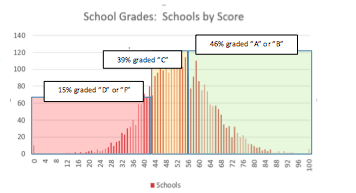 Among the 3,214 schools graded as part of the 2016 (A-F) School Grades System, 15% received a “D” or “F” while 39% were graded a “C” and 46% received and “A” or “B”.[2] If this scoring system is compared to a normal bell curve, twice as many schools are receiving “A”s and “B”s as would be expected to receive those scores.
There are 300 schools classified as Alternative Education schools serving 25,000 students. These schools are classified as alternative because they are Special Education schools, disciplinary alternative schools and dropout prevention and recovery schools. The students in these schools were previously the most-off-track students at their prior, regular education sites. This year, 106 of these schools will receive accountability grades, based solely on standardized assessment gains, under the School Improvement Rating (“SIR”) system proposed by FLDOE staff for approval at the September State Board meeting. 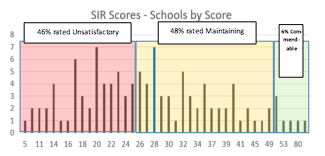 As proposed by the Accountability Department, 46% will receive an “Unsatisfactory” (equivalent to an “F”). This will occur because the trigger for a school receiving a failing grade is set 3 percentage points below the average of all alternative schools.[3] If this scoring system is compared to a normal curve, twice or three times as many schools are receiving an “Unsatisfactory” as expected.
Our Position – First, in response to the FLDOE proposal on the table, the treatment of Learning Gain results should be handled in an even-handed fashion. The FLDOE is proposing that a school scoring 3 percentage points below the average, will be deemed “Unsatisfactory.” However, a school must score 22 percentage points above the average to be deemed “Commendable.” To give parents and schools the reassurance that the system is fair to high performing as well as other alternative education schools, the scoring bands should be equal. As for how wide the bands should be, using a simple bell curve approach suggests that schools which are more than 12 percentage points below average should be deemed “Unsatisfactory” and those that are more than 12 percentage points above average should be deemed “Commendable.”
Second, but more importantly in the long run, the entire alternative education accountability system must be made far more rigorous and extensive. Relying on a single measure like Learning Gains, as the FLDOE currently uses, does not hold alternative education schools sufficiently accountable for the needs of their at-risk populations. Often the only hope for students who have dropped out or are about to drop out is alternative education schools. This means that alternative education schools are the last chance that off-track, at-risk students have to earn a diploma and to become successful Floridians. The FCSA wants to be certain that alternative education schools can show that they are also the “BEST” hope for at risk students. Below are our specific prescriptions for improving the alternative education or SIR system:
- Currently the School Improvement Rating or SIR system uses solely the Learning Gain measures from the regular accountability system to grade alternative schools. Restricting alternative education accountability to one measure is not holding these schools accountable enough. Furthermore, the Learning Gains themselves ignore students who manage to pass a concordant examination and they ignore many students who manage to overcome prior failures by passing retake exams. These ignored students should be added to the mix when setting a Learning Gain measure for alternative education schools.
- While the Learning Gains themselves need to be improved, it is crucial that the SIR ratings be expanded much further. These schools should be accountable for improving the behavior of students who have been suspended for serious infractions; for improving the basic reading and math skills of off-track students; for helping students with post-secondary planning. These changes will require new legislation.
- In light of the need for expanded legislation, the FCSA will work with Department of Education leaders, school districts, alternative education schools, authorizers of alternative education charters and other stakeholders to seek legislation that holds alternative education schools accountable to the particular students they serve.
For more information about the FCSA’s SIR / Alternative Accountability Position Paper, please contact Ralph Arza.
[1] Source: “About Us,” webpage, FLDOE website, accessed August 2016.
[2] Source: “Florida School Grades: 2015-16 School Grades, July 2016,” FLDOE website, July 2016.
[3] Source: Spreadsheet provided to Florida Charter Schools Alliance by FLDOE on July 28, 2016.