

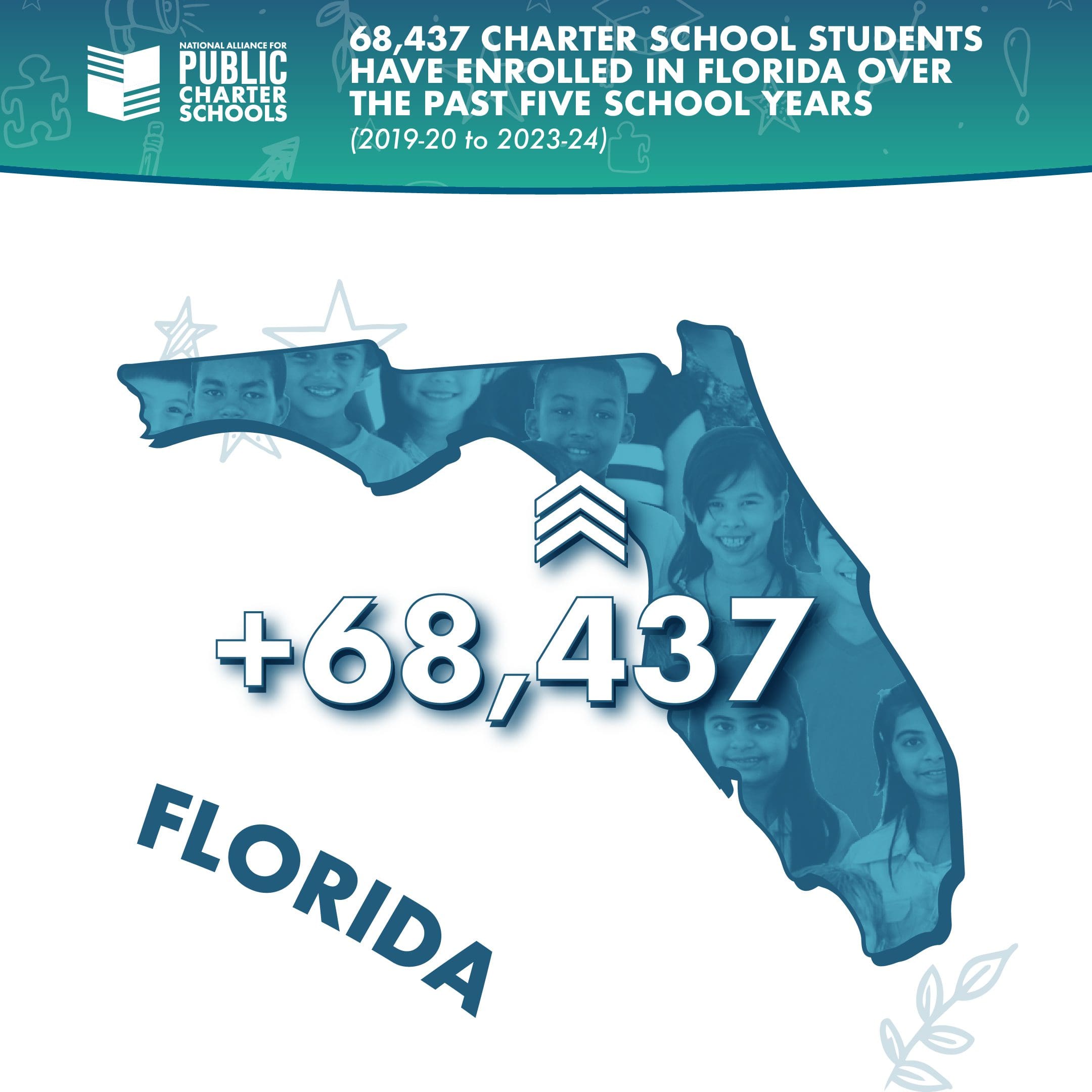
Florida experienced a 20.79% increase in charter school enrollment over the last five years.
According to state-level data analyzed by the National Alliance for Public Charter Schools in a new report, Do You Know Where the Children Are? A Five-Year Analysis of Public School Enrollment, for the 2023-24 school year, Florida’s public charter school enrollment grew by 4 percent or 15,289 students. Charter schools in Florida were the only type of public schools to grow this year.
Nationally, over the past five years, charter schools gained nearly 400,000 students, while district schools lost 1.75 million. Hispanic and Black families are increasingly choosing charter schools, with Hispanic enrollment growing 18 times faster in charters than in district schools. Over the past five years, enrollment in Florida’s public charter schools has grown by 20.79% or 68,437 students.
Nationally, over the past five years, charter schools gained nearly 400,000 students, while district schools lost 1.75 million. Hispanic and Black families are increasingly choosing charter schools, with Hispanic enrollment growing 18 times faster in charters than in district schools. In Florida, over the past five years, charter schools gained more than 40,300 Hispanic students — a gain of 28.07%, and 9,221 Black students — a 14.3% gain while non-charter schools saw a decline of close to 5%.
“The enrollment gains are a testament to the quality charter school programs and academic results, as well as the commitment from operators, governing board members, and stakeholders to continuously improve, innovate, and develop exceptional academic initiatives that parents want and students need,” said Lynn Norman-Teck, Executive Director, Florida Charter School Alliance.
Florida charter schools earned an “A” in the 23-24 school year. Florida’s public charter schools’ combined student population of over 397,000 makes them larger than most of the individual school districts in the state. Florida Department of Education student performance data from 2023-24 indicates that Florida’s public charter schools — as a whole — have excelled in various areas, such as student achievement and progress, and reflect a high level of performance and effectiveness in meeting educational standards. “Although a school grade is not the only measure of success, it does provide a performance measure that parents and lawmakers understand. It’s also a critical measure of achievement and learning gains, middle school acceleration, graduation rate, college and career acceleration, and whether or not schools are meeting the needs of students who require the most support,” explains Norman-Teck.
What the report found:
- Charter school enrollment has steadily increased by nearly 400,000 students over the past five years, while district public schools have lost about 1.75 million students. Year-to-year, charter school enrollment grew by 83,172 in 2023-24, while district public schools saw a decline of 274,412 students.
- Charter schools have seen significant gains in Black and Hispanic student enrollment, with Hispanic enrollment growing 18 times faster than in district schools. White student enrollment in district schools has sharply declined, while charter schools have shown modest growth in White students.
- Charter schools have consistently outperformed expectations based on child population shifts, with 84% of states showing charter enrollment growth that exceeds school-aged population growth. In contrast, district schools underperformed child population trends, particularly for White and Black students, indicating a growing preference for charter schools.
The shift in public school enrollment patterns has been driven by a variety of factors, including parental desire for more innovative and personalized learning environments. As of 2023-2024, 80% of students are still enrolled in their zoned public school, but more families each year are choosing alternatives like charter schools. This report explores key trends over the past five years, particularly in how charter schools are serving diverse racial and ethnic groups. The data show that whether a state’s population is shrinking or growing, charter school enrollment consistently outpaces demographic changes, indicating that the appeal of charter schools extends beyond simple population growth.